
Published July 3, 2026 · By Chris Nevada, Nevada Real Estate Group · NV License S.181401
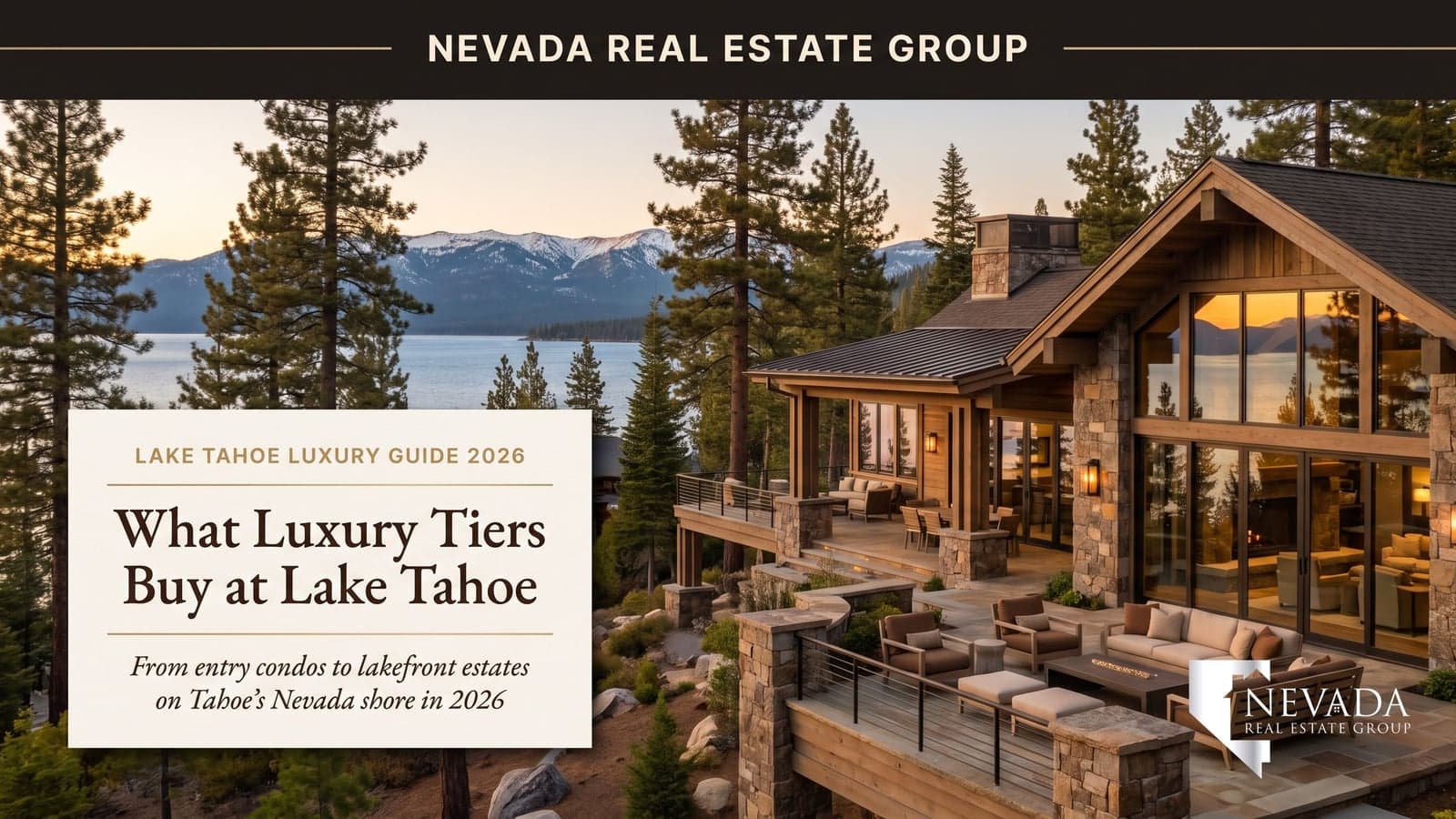
"What does my budget actually buy at Lake Tahoe?" is the question I hear most from buyers eyeing the Nevada side of the lake, and it is the right one — because Tahoe is a tiered luxury market where the jump from one price band to the next changes everything: proximity to the water, views, lot size, and whether you are buying a lock-and-leave condo or a legacy lakefront estate. In 2026 Nevada-side Tahoe real estate spans from roughly $800,000 for an entry condo to $50 million-plus for a trophy lakefront, concentrated in Incline Village, Crystal Bay, Zephyr Cove, and Glenbrook. This guide walks exactly what each luxury tier buys, then explains how financing, ownership, and Nevada residency work at the lake.
Nevada-side Lake Tahoe real estate spans four broad tiers in 2026: entry condos and townhomes from about $800,000 to $1.3 million; single-family homes from roughly $1.5 to $3 million; luxury homes with views from about $3 to $8 million; and ultra-luxury lakefront estates from $8 million past $50 million. Most inventory sits in Incline Village and Crystal Bay. Tier, not just size, sets the price. Call (775) 277-2120.
- Nevada-side Tahoe entry condos start around $800,000; lakefront estates exceed $50 million.
- Incline Village and Crystal Bay hold most of the Nevada-side inventory and amenities.
- Nevada residency at Tahoe means no state income tax — a major draw for relocating buyers.
- Higher tiers usually require jumbo financing or all-cash; luxury deals are frequently cash.
- Lakefront and lake-view properties command the steepest premiums and hold value best.
How we know this: Across the 9,600+ closings Nevada Real Estate Group has represented statewide — more than $4.85B in closed volume — the Nevada side of Lake Tahoe is one of our most distinctive luxury markets. In my experience, buyers who understand which tier their budget lands in, and what that tier realistically delivers, make far better decisions than buyers anchored on square footage alone. The figures below reflect that transaction experience plus 2026 pricing observed across the Nevada shore; confirm current comps for your target area and tier before you write an offer.
What Are the Luxury Price Tiers at Lake Tahoe in 2026?
According to Nevada REALTORS, whose members cover the Nevada-side Tahoe market, prices span an enormous range driven almost entirely by proximity to the water and views. The tier you can reach determines the entire character of the purchase — a lock-and-leave condo, a full-time family home, a view retreat, or a legacy lakefront estate. This table gives the 2026 tier map before the detail.
| Tier | Price band | Typical property | Best for |
|---|---|---|---|
| Entry | $800K – $1.3M | Condo or townhome | Lock-and-leave / first Tahoe home |
| Single-family | $1.5M – $3M | Detached home, some views | Full-time or second home |
| Luxury | $3M – $8M | Larger home, lake or forest views | View retreat / legacy home |
| Ultra-luxury lakefront | $8M – $50M+ | Lakefront estate with pier | Trophy / generational asset |
The pattern is clear: at Tahoe you are buying access to the water and the views as much as the house itself. Explore the market on our Lake Tahoe and Incline Village pages, and read our Lake Tahoe market report for current conditions.

What Does the Entry Tier Buy at Lake Tahoe?
The entry tier — roughly $800,000 to $1.3 million — buys a condo or townhome, most commonly in Incline Village. These are the lock-and-leave properties that get buyers into the Nevada-side Tahoe market without an estate-sized budget: one-to-three-bedroom units, often within walking or short driving distance of the lake, ski access, and Incline's amenities. Many are second homes or rental-capable properties for owners who visit seasonally.
I steer first-time Tahoe buyers and lock-and-leave seekers here when they want the lake lifestyle and the Nevada tax advantages without full-estate ownership. The trade-off is that you are buying proximity and lifestyle, not a private lakefront or a large lot. According to Nevada REALTORS, entry-tier inventory is the most liquid part of the Nevada-side market. For buyers weighing a second home, our guide on buying a second home in Incline Village covers the specifics.
A key advantage of the entry tier is that Incline Village property owners gain access to the community's private amenities — beaches, recreation, and facilities that are among the best on the lake — so even a modest condo confers a genuine Tahoe lifestyle. That access is part of why entry-tier units hold value and rent well. The main considerations are HOA dues, which fund building and community amenities, and any short-term-rental restrictions if you plan to offset costs by renting when you are away. I walk buyers through the specific building's rules, dues, and rental policies before they commit, because these vary significantly across Incline's condo and townhome projects and directly affect both your carrying cost and your flexibility as an owner.
What Does the Single-Family Tier Buy at Lake Tahoe?
The single-family tier — roughly $1.5 to $3 million — buys a detached home, typically in Incline Village or Crystal Bay, sometimes with filtered lake or forest views. This is where full-time residents and serious second-home buyers land: three-to-four-bedroom mountain homes on wooded lots, with the space and privacy a condo cannot offer, and access to Incline's private beaches and recreation for property owners. It is the heart of the Nevada-side residential market.
I bring this tier into the conversation for buyers who want a real home at the lake — for full-time living, a family retreat, or a long-term hold — rather than a lock-and-leave unit. According to the U.S. Census, Incline Village's households skew affluent and older, reflecting exactly this ownership profile. Compare the Nevada-side communities on our Northern Nevada communities directory before deciding.
Within this tier, location nuances matter enormously. A home a few blocks from the lake with filtered views can trade well below an otherwise similar home with an open lake view, and proximity to Incline's amenities, the golf courses, and ski access all move value. Winter accessibility is another real factor — some streets and lots handle heavy snow and steep grades better than others, which affects both daily livability and long-term appeal. I help buyers weigh these trade-offs, because two homes at the same price in the same community can offer very different experiences depending on view, grade, sun exposure, and how they live through a Sierra winter. For a full-time residence in particular, these practical factors often matter more than an extra bedroom.

What Does the Luxury Tier Buy at Lake Tahoe?
The luxury tier — roughly $3 to $8 million — buys a larger, higher-end home with genuine lake or forest views, superior finishes, and often a prime location within Incline Village, Crystal Bay, or the Zephyr Cove and Glenbrook areas to the south. Expect four-to-six-bedroom homes with architect-designed interiors, outdoor living built for the alpine setting, and, at the top of the band, meaningful lake views or near-lakefront positioning. These are legacy homes buyers hold for decades.
I position this tier for buyers who want a view retreat or a generational family home and have the budget to command a prime location. According to the Federal Housing Finance Agency, the region has posted strong long-run appreciation, and Tahoe's view and near-lakefront properties have led it, buoyed by scarce supply and durable demand. Compare guard-gated and view-oriented options across the state on our guard-gated communities and luxury communities pages.

What Does the Ultra-Luxury Lakefront Tier Buy at Lake Tahoe?
The ultra-luxury tier — from about $8 million past $50 million — buys the trophy: a lakefront estate with private beach frontage, a pier, and the kind of setting that defines Lake Tahoe's global reputation. These are the rarest and most valuable properties on the Nevada shore, concentrated in enclaves like Lakeshore Boulevard in Incline Village, Crystal Bay, and the historic Glenbrook area. They trade infrequently, often off-market, and represent generational, trophy-asset ownership.
I represent buyers and sellers at this tier with the discretion and market intelligence it demands, because these deals are as much about access and relationships as listings. Lakefront supply is fixed — there is only so much Nevada shoreline — so these estates hold and grow value on pure scarcity. According to the Financial Crimes Enforcement Network, high-value all-cash residential purchases carry beneficial-ownership reporting in certain markets, so the paperwork at this tier is its own discipline. For the right buyer, a Tahoe lakefront is among the most coveted real assets in the American West.
How Do the Nevada-Side Tahoe Communities Compare?
The Nevada shore is not one market — Incline Village, Crystal Bay, Zephyr Cove, and Glenbrook each have a distinct character. The matrix below summarizes how they differ for buyers.
| Community | Character | Inventory depth | Entry point |
|---|---|---|---|
| Incline Village | Amenity-rich, full-service | Deepest (condos to lakefront) | From about $800K |
| Crystal Bay | Quieter, wooded, exclusive | Limited | From about $1.2M |
| Zephyr Cove | South-shore lake access | Limited | From about $1M |
| Glenbrook | Historic, gated, ultra-exclusive | Very limited | From several $M |
Incline Village offers the deepest inventory and the most amenities — private beaches, recreation, golf, and services for property owners — which is why most Nevada-side buyers start there. The smaller communities trade depth for exclusivity and privacy. I match buyers to the community whose character fits how they want to use the lake, whether full-time, seasonal, or as a legacy asset.
How Does Nevada Residency Change the Math at Lake Tahoe?
One of the biggest reasons buyers choose the Nevada side of Lake Tahoe over the California side is taxes. Nevada has no state income tax, while California's top marginal rate is among the nation's highest, so for high-income and high-net-worth buyers, establishing Nevada residency at a Tahoe home can produce substantial annual savings. According to the Nevada Department of Taxation, the state's framework — no income tax, moderate property tax on assessed value — is a core part of the Nevada-side value proposition.
That tax dynamic is why the Nevada shore commands a premium and why so many of my Tahoe buyers are relocating executives, business owners, and retirees moving assets and residency across the state line. Establishing bona fide Nevada residency has specific requirements — days in state, domicile intent, and more — so I always advise buyers to work with a qualified tax and legal advisor alongside the purchase. Done correctly, the residency benefit can materially change the effective cost of Tahoe ownership. Our Reno relocation guide covers the wider Northern Nevada move.
How Do You Finance a Lake Tahoe Luxury Home?
Financing changes as you move up the tiers. Entry and single-family purchases often use conventional or jumbo loans, while luxury and ultra-luxury deals frequently close all-cash or with portfolio and private-bank financing tailored to high-net-worth buyers. Above the conforming loan limit, you are in jumbo territory, which means stricter reserves, larger down payments, and lenders who specialize in luxury and second-home lending.
| Tier | Common financing | Typical down payment |
|---|---|---|
| Entry ($800K–$1.3M) | Conventional or jumbo | 10–25% |
| Single-family ($1.5M–$3M) | Jumbo, some cash | 20–30% |
| Luxury ($3M–$8M) | Jumbo, portfolio, or cash | 30%+ or all-cash |
| Ultra-luxury ($8M+) | Private bank or all-cash | Frequently all-cash |
According to the Consumer Financial Protection Bureau, comparing offers from multiple lenders matters even more at high loan amounts, where small rate differences translate into large dollar swings. At the top tiers, cash is common — a meaningful share of Tahoe luxury purchases close without a mortgage — which also affects negotiating dynamics. I connect buyers with lenders and private banks experienced in Tahoe luxury and second-home financing, and I structure offers to compete effectively whether you are financing or paying cash. Our buyer resources cover the broader process.
What Should You Know Before Buying a Home at Lake Tahoe?
Beyond price and tier, Tahoe ownership has realities that flatland buyers underestimate. Winter is real: snow load, road access, and heating shape both lifestyle and cost, and some properties are more winter-accessible than others. Many purchases are second homes, so factor in caretaking, potential short-term-rental rules, and HOA or community-association requirements, which vary by area and can restrict rentals. Insurance, including wildfire considerations in the Sierra, is another line to underwrite carefully.
According to Nevada Revised Statutes Chapter 116 governing common-interest communities, associations must maintain reserves and disclose their finances, so read the documents on any HOA-governed property. In my experience, the buyers who are happiest at Tahoe are the ones who understand they are buying a mountain, lakeside lifestyle with its own rhythms and responsibilities, not just a house. I walk buyers through all of it before they commit, so the dream property does not come with unwelcome surprises.
What Does It Cost to Own a Lake Tahoe Home Each Year?
Beyond the purchase price, Tahoe ownership carries costs that scale with the property and that flatland buyers often underestimate. Property taxes run on Nevada's moderate assessed-value framework, which is favorable compared with many high-cost markets, but on a multimillion-dollar home the dollar figure is still substantial. Insurance is a bigger variable than in the valley: wildfire risk in the Sierra has made coverage more expensive and, on some properties, harder to place, so I have buyers underwrite insurance early rather than assume it.
Then there are the mountain-specific costs — snow removal, heating, caretaking for a second home, and higher maintenance for homes exposed to heavy winters. HOA or community-association dues, where they apply, fund amenities and shared infrastructure and vary widely by area. According to Washoe County, the assessed-value basis keeps the tax line predictable, but the all-in annual cost of a Tahoe home is meaningfully higher than the mortgage alone suggests. I build a full annual-cost model for serious buyers, because a clear picture of taxes, insurance, utilities, caretaking, and dues is essential before committing to a mountain-lake property at any tier.
How Fast Does Nevada-Side Tahoe Inventory Move?
Tahoe moves differently than a metro market. Supply is fundamentally limited — the Nevada shore is small and largely built out, and lakefront is fixed — so even a modest number of motivated buyers can absorb the available inventory quickly, especially for well-priced, well-located properties. The entry condo tier in Incline Village is the most liquid, while lakefront estates trade rarely and often quietly.
There is a strong seasonal rhythm. Spring and summer bring the most listings and the most buyer activity, as the lake shows at its best, while winter slows the pace and can hand prepared buyers more leverage. In my experience, the defining feature of Tahoe is scarcity, not speed — the right property in the right location and tier may not come to market often, so serious buyers stay ready and move decisively when it does. At the luxury and ultra-luxury tiers especially, much of the best inventory never reaches the public portals, which is why relationships and market intelligence matter as much as any listing search. I keep qualified buyers informed of quiet and coming-soon opportunities across the Nevada shore.
How Do I Choose the Right Lake Tahoe Property?
Start by identifying your tier honestly, then define how you will use the property — lock-and-leave condo, full-time home, view retreat, or legacy lakefront. That pairing narrows the search quickly. From there we focus on the community and specific properties that fit, weighing views, water access, winter accessibility, and the tax-residency angle if it applies to you. At the higher tiers, much of the best inventory is quiet or off-market, so relationships and market intelligence matter as much as the public listings.
The buyers who do best at Tahoe match tier to intended use, then buy the best location within it, because at the lake, location and water access drive value above all. As the lead brokerage serving Northern Nevada, Nevada Real Estate Group represents buyers and sellers across every Tahoe tier with the discretion the market demands. Call our team at (775) 277-2120, or contact us to explore current Nevada-side Tahoe inventory.
Frequently Asked Questions
How much does a home at Lake Tahoe cost in 2026?
On the Nevada side, Lake Tahoe real estate spans from about $800,000 for an entry condo or townhome to $50 million-plus for a trophy lakefront estate in 2026. Single-family homes run roughly $1.5 to $3 million, and luxury homes with views run about $3 to $8 million. Most inventory sits in Incline Village and Crystal Bay. The tier you can reach, and proximity to the water, sets the character of the purchase.
Is it better to buy on the Nevada or California side of Lake Tahoe?
For high-income and high-net-worth buyers, the Nevada side often wins on taxes: Nevada has no state income tax, while California's top rate is among the nation's highest, so establishing Nevada residency at a Tahoe home can produce substantial annual savings. The California side has its own communities and character, but the tax advantage is a core reason many buyers choose the Nevada shore, especially in Incline Village and Crystal Bay.
What is the entry price to buy at Lake Tahoe on the Nevada side?
The entry point is roughly $800,000, typically for a condo or townhome in Incline Village. This tier gets buyers into the Nevada-side market with a lock-and-leave property near the lake, ski access, and amenities, without an estate-sized budget. Detached single-family homes generally start around $1.5 million, and true lakefront estates begin around $8 million and climb well past $50 million.
Do you need cash to buy a Lake Tahoe luxury home?
Not always, but it is common at the higher tiers. Entry and single-family purchases often use conventional or jumbo financing, while luxury and ultra-luxury deals frequently close all-cash or with private-bank and portfolio financing. Above the conforming limit you are in jumbo territory with larger down payments and reserve requirements. A meaningful share of Tahoe luxury purchases close without a mortgage, which also shapes negotiating dynamics.
Can I save on taxes by establishing Nevada residency at Lake Tahoe?
Potentially, yes, and it is a major driver of Nevada-side demand. Nevada has no state income tax, so high-income buyers who establish bona fide Nevada residency at a Tahoe home can save substantially versus California. Residency has specific requirements around days in state and domicile intent, so work with a qualified tax and legal advisor alongside the purchase. Done correctly, the benefit can materially change the effective cost of ownership.
Do I need a local agent to buy a Lake Tahoe luxury home?
It helps significantly, especially at the higher tiers. Nevada-side Tahoe involves tiered luxury pricing, off-market inventory, winter-access and wildfire-insurance considerations, HOA and rental rules, jumbo and private-bank financing, and the Nevada residency angle. A local specialist with luxury market intelligence and relationships surfaces the right properties and structures competitive offers. Our Northern Nevada team represents buyers and sellers across every Tahoe tier — reach us at (775) 277-2120.
Which Sources Inform This Lake Tahoe Luxury Guide?
- Nevada REALTORS — market and pricing data
- Washoe County Assessor — property assessment and tax
- Nevada Department of Taxation — Nevada tax framework
- Nevada Revised Statutes Chapter 116 — common-interest community (HOA) law
- U.S. Census Bureau — Incline Village demographics
- Consumer Financial Protection Bureau — mortgage and jumbo financing guidance
- Financial Crimes Enforcement Network — high-value all-cash reporting
- Federal Housing Finance Agency — house price index
This guide reflects conditions current as of mid-2026 and is informational only; luxury pricing, inventory, and tier boundaries change constantly — verify current comps for your target area and tier before purchasing, and consult a qualified tax advisor on Nevada residency. Nevada Real Estate Group · Chris Nevada · License S.181401 · (775) 277-2120.